
SHADE SAIL BUILDER BLOG
Can Your Phoenix HOA Ban a Shade Sail? What Arizona's New Law Means for Backyard Shade
This article is general information about a new Arizona statute, written for Valley homeowners. It is not legal advice. For a decision about your lot or a dispute, talk with an Arizona attorney or your community manager and read your community documents alongside the law.
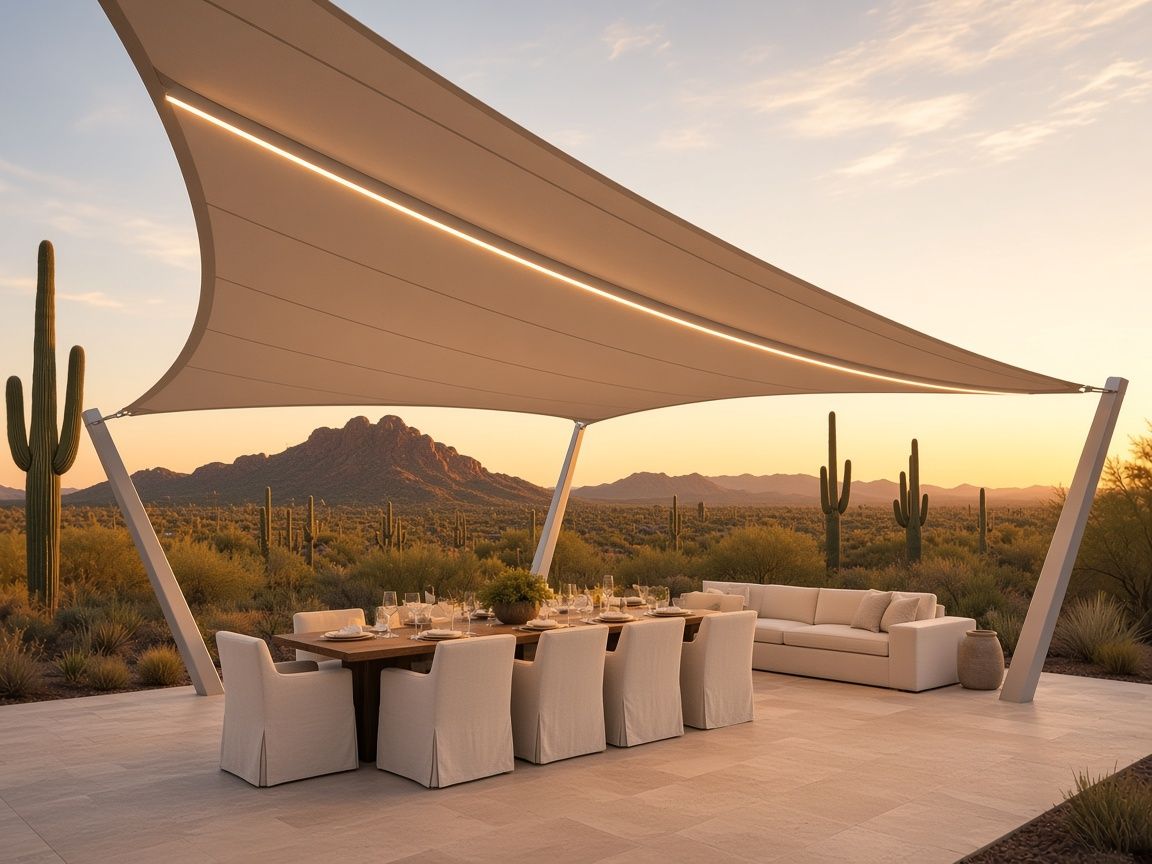
If you have lived in a Phoenix-area HOA, you have probably wondered whether the architectural committee will allow a shade sail over the patio or the pool. Arizona's new backyard shade-structure law, House Bill 2342, changed that conversation.
Planned community associations can no longer put a blanket ban on qualifying backyard shade structures, including shade sails. They can still set reasonable rules on size, placement, and appearance, and they can still ask you to submit a request first. The practical next step is a clean submittal: real measurements, a color that fits the house, and anchors that can handle monsoon wind.
What HB 2342 actually says
The bill is now Arizona law. The Legislature enacted it as Chapter 90 in the 2026 regular session. The official session law was approved by the Governor on June 4, 2026, and added A.R.S. § 33-1816.01 to the planned-community statutes. The House research summary shows no emergency clause, and under the Arizona Legislature's general effective date for that session, the law took effect on September 12, 2026.
In plain language, the chaptered text does three things. A planned community association may not prohibit the backyard installation or use of a shade structure, even if the community documents say otherwise. The association may still adopt reasonable rules about size, placement, or appearance, but those rules may not prevent installation, impair the functioning of the structure, restrict its use, or unreasonably affect its cost. They also may not be more restrictive than the city or town zoning rules on shade-structure height and setbacks for a single-family home in that community.
The statute defines a "shade structure" as a commercially produced or professionally manufactured moveable or permanent structure designed to protect an area from sunlight, including an umbrella, awning, shade sail, gazebo, pergola, or canopy.
A few limits matter as much as the rights. The new section sits in Title 33, Chapter 16, which governs planned communities, and does not, on its face, amend the separate condominium chapter. The protection is written for the backyard, not the front yard or common area. A custom sail or a factory kit can both fit the definition. The law does not promise that every kit is a good idea in Phoenix wind.
What your HOA can still review
The law did not end architectural review. It narrowed what an association can forbid.
Your HOA can still ask for an architectural request before you install. It can still care about color, how the sail sits on the lot, how tall the posts are, and whether the layout looks finished.
What they cannot do is use a community rule as a blanket "no sails" policy in the backyard, or write height and setback rules stricter than local zoning for a single-family home. They also cannot adopt "reasonable" rules that, in practice, prevent the install, keep the sail from working, stop you from using it, or unreasonably drive up the cost.
How to measure a sail so the submittal is accurate
Measure hole-center to hole-center, not post-center to post-center, and not the size of the finished fabric.
A shade sail does not run all the way to the posts. Hardware takes up space at each corner: a bracket, a shackle, a turnbuckle, and the D-ring sewn into the sail. If you measure the posts and order a sail that large, the fabric will be too big to tension.
Identify each attachment point, then measure from the center of one shackle or bracket hole to the center of the next, including the diagonals on a four-corner sail. Note the height of each point above the ground. Label the corners, write the distances in feet and inches, and photograph the yard. If the posts are not in yet, show the proposed locations. Before anyone cuts fabric, those hole-to-hole distances need to be final.
Wind and monsoon: why a backyard sail is not an Amazon tarp
The new law talks about the right to install a qualifying structure. It does not change Arizona weather.
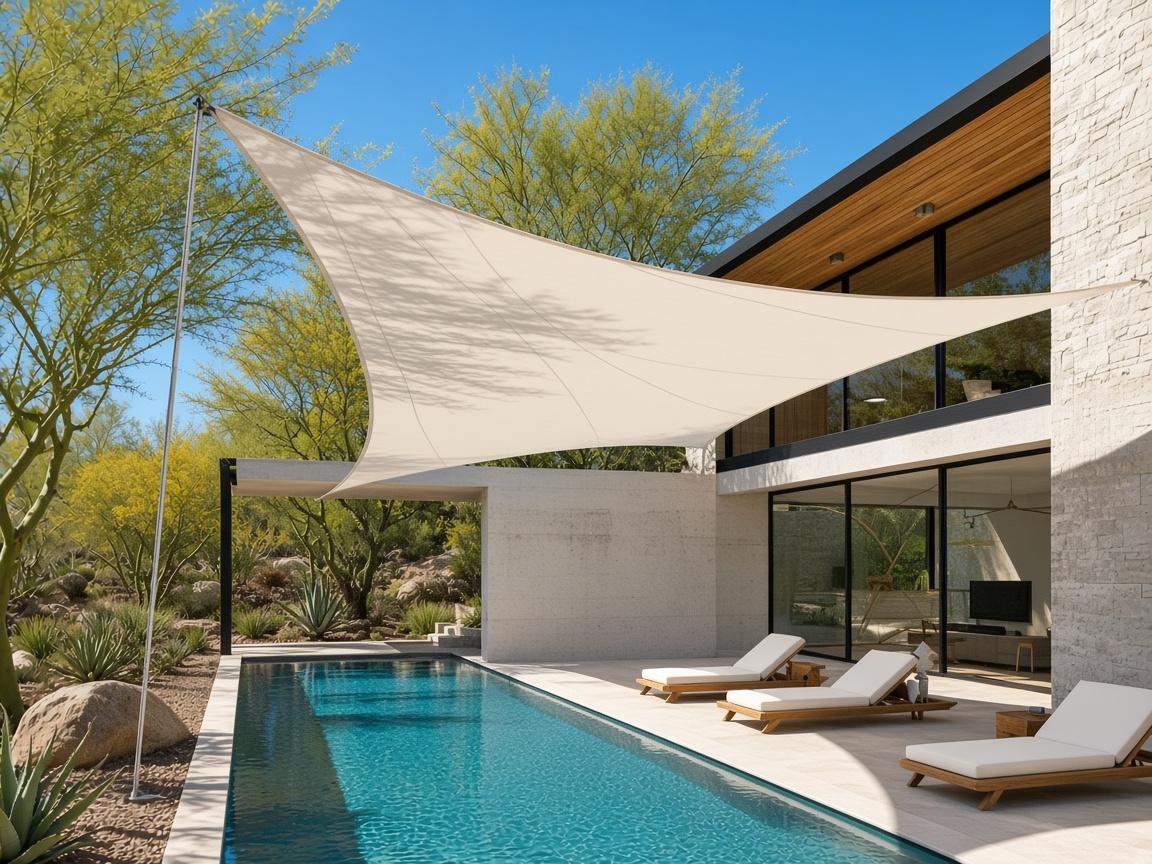
In a July outflow, a shade sail behaves like a sail. The load shows up at the corners, the posts, and whatever those posts are attached to. That is why so many weekend installs fail here, and why you should not anchor a tight sail to a cinder block wall.
A sail meant to stay up through the season needs fabric rated for sun, corrosion-resistant hardware, and posts or house attachments that can take the tension. A way to ease or remove the sail before a bad storm is not required by HB 2342, but it is how many Phoenix installs survive July.
A simple HOA packet checklist
You do not need a thick binder. You do need enough detail that a neighbor on the committee can understand the job.
- A simple plan of the backyard showing the house, the patio or pool, and each post or attachment point
- Hole-center to hole-center distances, including diagonals, plus the height of each corner
- The sail shape and whether it is one sail or more
- Fabric type and color, with a sample photo if you have one
- A note on posts and anchors: existing or new, and that you are not tying a tensioned sail to a block wall
- Product or manufacturer information showing a commercially produced or professionally manufactured structure
- A short note that the layout is meant to meet association appearance rules and any city setback or height limits
When a city or town permit may still be required
HB 2342 is an HOA statute. It does not replace building permits, zoning, or lot-coverage rules in Phoenix, Mesa, Scottsdale, Chandler, Gilbert, or anywhere else in the Valley.
Whether you need a permit depends on the city or town and on the job: whether the sail or its frame is attached to the house, whether new posts are set in concrete, the size of the structure, and whether you are adding lights or other utilities. Zoning setbacks and height limits can still apply even when a building permit is not required. The new law only says that an association's height and setback rules for a backyard shade structure cannot be stricter than the local zoning ordinance for a single-family home.
Before you dig, check with your building department, not just the HOA. A clean HOA approval does not take the place of a city permit.
A straightforward way to see the layout first
If you want to look at shape, color, and a simple layout before you fill out a request, you can do that in the 3D designer at shadesailbuilder.com. It is a design tool, not a substitute for HOA approval or a permit. If you would rather talk through the yard first, call 480-695-7273. I am in Scottsdale.
FAQ
Can my Phoenix HOA still ban a shade sail in the backyard?
Not with a blanket ban, if you live in a planned community and the sail qualifies. The association may still apply reasonable rules on size, placement, and appearance. You should still submit an architectural request.
Does this law apply to condominiums and front yards?
The enacted section was added to Arizona's planned-community statutes and covers backyard installation and use. It does not, by its own terms, amend the condominium statutes or cover a front-yard or common-area install.
Do I still need HOA approval if the law is on my side?
In most communities, yes. A complete measurement and color packet is usually the fastest way through reasonable review.
Does HB 2342 mean I do not need a building permit?
No. The law does not change city or town permit, zoning, or inspection rules.
Sources
- Arizona Session Laws, Chapter 90, Fifty-seventh Legislature, Second Regular Session (2026), enacting A.R.S. § 33-1816.01: https://www.azleg.gov/legtext/57leg/2R/laws/0090.htm
- Arizona House of Representatives signed bill summary for HB 2342 (Chapter 90; no emergency clause): https://www.azleg.gov/legtext/57leg/2R/summary/H.HB2342_061826_SIGNED.pdf
- Arizona Legislature, general effective dates (Fifty-seventh Legislature, Second Regular Session: September 12, 2026): https://www.azleg.gov/general-effective-dates/
- Arizona Senate, 2026 Legislative Summary (session adjourned sine die June 13, 2026; general effective date September 12, 2026): https://www.azleg.gov/alispdfs/57leg/2R/Senate/SummaryComplete.pdf